
Finger exercises to build strength, coordination, and clean fretting from the first session.
Major Ionian Foundations
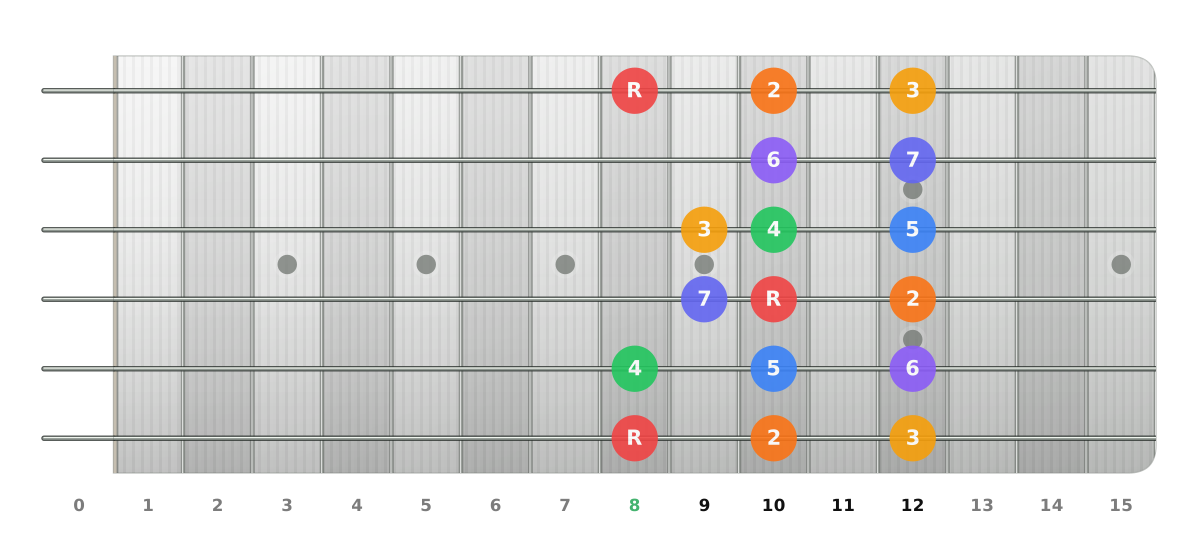
Learn the major/Ionian diatonic fretboard as one parent map, then connect mechanics, scales, arpeggios, chords, progressions, and jams across shifting harmonic centers.
Each stage centers one musical target. Its activities stay grouped together so the course reads as a path through the fretboard, not a list of disconnected drills.
- For Intermediate Players
- Interactive Course
- Pentatonic or Blues Recommended
- Stages
- 7
- Lessons
- 41
- Targets
- 386
Stage breakdown
Ionian stays visible as the parent map while each stage shifts the harmonic target and adds the positions needed for that sound.
Start on the I chord with one neck position, clear sequence targets, chord-shape targets, and a first jam.
5Tracks5Lessons15Targets
Interactive scale practice connects patterns, position shifts, and lead-guitar phrasing across the fretboard.
Interactive arpeggio practice connects chord tones, position shapes, and lead-guitar lines that follow the changes.
Build the tonic seventh chord from Ionian harmony inside Position 1.
Combine scales, arpeggios, and chords from course stages to learn how to improvise solos on the guitar.
Shift to the vi sound. Keep Ionian as the visual map, add Position 3 beside Position 1, and connect vi back to I.
6Tracks6Lessons30Targets
Finger exercises to build strength, coordination, and clean fretting from the first session.
Work the relative minor from degree 6 while keeping the Ionian map visible for learners.
Shift the arpeggio lane to roman vi and clear the same three sequence shapes in both positions.
Build the relative-minor seventh chord inside the newly introduced Position 3.
Practice the first two-chord movements of the course: vi minor 7 back to I major 7, then I major 7 into vi minor 7.
Move between the familiar I major 7 chord in Position 1 and the new vi minor 7 chord in Position 3 without losing the parent Ionian map.
Add Position 5 and center the sequence work on degree 5 while staying in the Ionian map.
6Tracks6Lessons46Targets
Finger exercises to build strength, coordination, and clean fretting from the first session.
Scale practice connects patterns, position shifts, and lead-guitar phrasing across the fretboard.
Arpeggio practice connects chord tones, position shifts, and lead-guitar phrasing across the fretboard.
Guided chord practice teaches chord shapes, cleaner changes, and stronger rhythm playing.
Progression practice builds rhythmic chord changes and common song movement through real chord sequences.
Jam practice turns scale, arpeggio, and chord work into soloing ideas over a groove.
Add Position 2 and shift the sequence center to degree 2 without leaving the Ionian map.
6Tracks6Lessons56Targets
Finger exercises to build strength, coordination, and clean fretting from the first session.
Add Position 2 and keep the same three sequence goals alive while centering on degree 2.
Keep the triad lane moving with the same sequence checks while centering on degree 2.
Add the minor 7 chord color before working the ii-V-I lane.
Work short ii-V-I phrases with minor 7, dominant 7, and tonic major 7 forms.
Add the supertonic minor color with two-bar phrases that move between I in Position 1 and ii in Position 2.
Add Position 4 and carry the cumulative position set into degree 4 Ionian-map work.
6Tracks6Lessons68Targets
Finger exercises to build strength, coordination, and clean fretting from the first session.
Fold Position 4 into the cumulative sequence checklist while centering on degree 4.
Keep the triad-only lane intact while the position map grows again around degree 4.
Add the major 7 color so IV is not just another major barre target.
Use IV major 7 as its own target and connect it back to I major 7 and V7.
Bring Position 4 online by hearing IV as a new solo target while the backing flips between I and IV.
Add Position 7 and center the sequence work on degree 7 while keeping the same parent map.
6Tracks6Lessons79Targets
Finger exercises to build strength, coordination, and clean fretting from the first session.
Add Position 7 and keep the sequence checklist intact while centering the work on degree 7.
Keep the triad lane clean and center it on degree 7 before adding further extensions.
Add the half-diminished seventh chord before resolving the leading-tone progressions.
Introduce the leading-tone half-diminished sound and resolve it cleanly back to I.
Add the last new neck anchor by trading I against the leading-tone shape in Position 7.
Add Position 6 and finish the foundation pass by centering the work on degree 3 across all seven positions.
6Tracks6Lessons92Targets
Finger exercises to build strength, coordination, and clean fretting from the first session.
Keep the cumulative position set and center the scalar work on degree 3 instead of switching the parent map.
Final triad-only foundation pass before extending the arpeggio lane, still inside the Ionian parent view.
Frame iii as the mediant minor 7 color instead of repeating the plain minor barre.
Use iii minor 7 to connect the mediant color back into familiar major 7 and minor 7 shapes.
Begin in the new Position 6, hear the mediant minor 7 cleanly, and return to the Position 1 tonic anchor.