
Finger exercises to build strength, coordination, and clean fretting from the first session.
Major Pentatonic Foundations
Learn all five major-pentatonic positions while turning movable power, major-barre, and minor-barre chords into practical major-key progressions and solo practice.
Each stage centers one musical target. Its activities stay grouped together so the course reads as a path through the fretboard, not a list of disconnected drills.
- For Beginners
- Interactive Course
- No Prerequisites
- Stages
- 5
- Lessons
- 24
- Targets
- 82
Stage breakdown
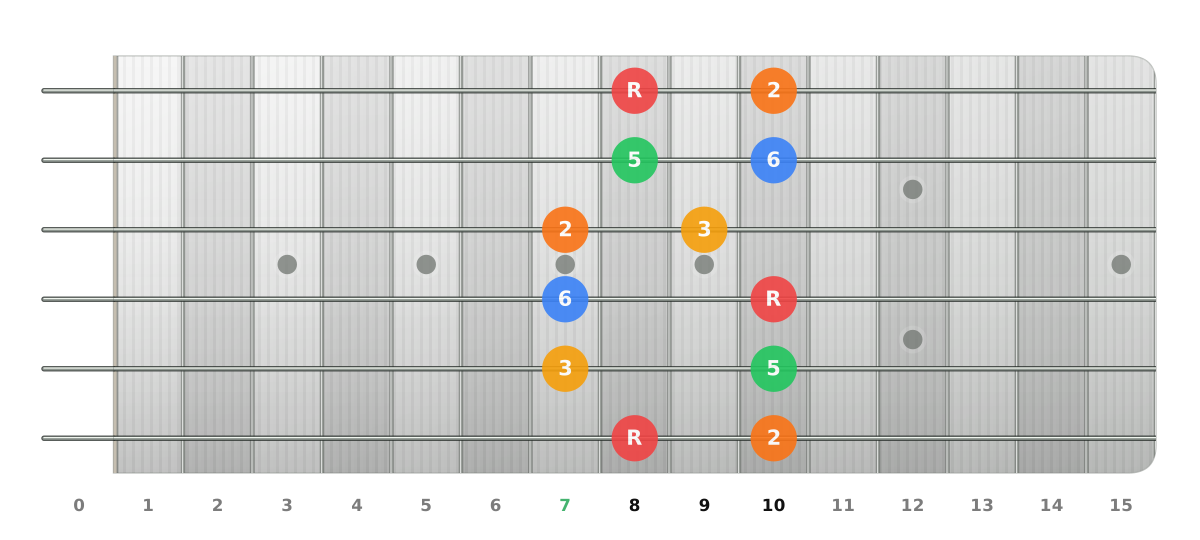
Major Pentatonic stays tonic-centered while each stage introduces the next of its five standard positions and applies it over diatonic major-key harmony with power and barre chords.
Establish Major Pentatonic Position 1, then connect its tonic root to movable I power and major-barre shapes.
4Tracks4Lessons7Targets
Map Position 1 with three practical sequence patterns.
Connect a Position 1 scale tone to practical sixth-string chord shapes.
Jam practice turns scale, arpeggio, and chord work into soloing ideas over a groove.
Add Position 2 around vi, introduce the movable minor barre, and connect the relative-minor sound back to tonic major.
5Tracks5Lessons13Targets
Finger exercises to build strength, coordination, and clean fretting from the first session.
Start in Position 2, then connect the earlier boxes with three sequence patterns.
Connect a Position 2 scale tone to practical sixth-string chord shapes.
Progression practice builds rhythmic chord changes and common song movement through real chord sequences.
Jam practice turns scale, arpeggio, and chord work into soloing ideas over a groove.
Add Position 3 around V, reinforce power and major-barre control, and hear dominant motion resolve into the tonic.
5Tracks5Lessons17Targets
Finger exercises to build strength, coordination, and clean fretting from the first session.
Start in Position 3, then connect the earlier boxes with three sequence patterns.
Connect a Position 3 scale tone to practical sixth-string chord shapes.
Progression practice builds rhythmic chord changes and common song movement through real chord sequences.
Jam practice turns scale, arpeggio, and chord work into soloing ideas over a groove.
Add Position 4, place the nearby diatonic IV chord root inside the same fret window while recognizing that it sits outside the five-note lead scale, and turn the first four boxes into major-key cadences.
5Tracks5Lessons21Targets
Finger exercises to build strength, coordination, and clean fretting from the first session.
Start in Position 4, then connect the earlier boxes with three sequence patterns.
Place the IV root inside Position 4's window as backing harmony.
Progression practice builds rhythmic chord changes and common song movement through real chord sequences.
Jam practice turns scale, arpeggio, and chord work into soloing ideas over a groove.
Add Position 5 around ii, complete the five-box map, and use every learned chord function in major-key turnarounds.
5Tracks5Lessons24Targets
Finger exercises to build strength, coordination, and clean fretting from the first session.
Start in Position 5, then connect the earlier boxes with three sequence patterns.
Connect a Position 5 scale tone to practical sixth-string chord shapes.
Progression practice builds rhythmic chord changes and common song movement through real chord sequences.
Jam practice turns scale, arpeggio, and chord work into soloing ideas over a groove.