
Finger exercises to build strength, coordination, and clean fretting from the first session.
Bebop Foundations
The course begins with root-started eighth notes over a major-six chord, then adds seven positions and major-key chord movements. Scale and arpeggio practice connect the passing tone to chord-tone landings, including its movement into the relative-minor root.
Build Ionian Bebop across seven positions, keep its flat-six passing tone melodic, and land steady eighth-note lines on functional major-key chord tones.
- For Advanced Players
- Interactive Course
- Diatonic Foundations Recommended
- Stages
- 7
- Lessons
- 41
- Targets
- 341
Practice requires a ScaleModePro account and access. You’ll be prompted to sign in or subscribe if needed.
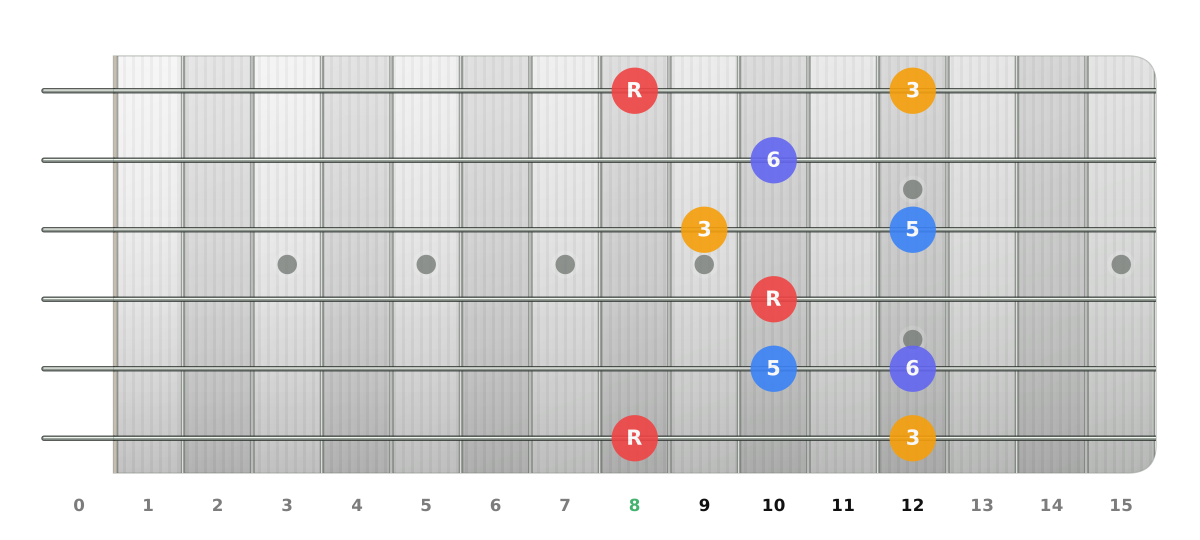
Stage breakdown
Ionian Bebop stays visible as the parent map while each stage shifts the harmonic target and adds the positions needed for that sound.
Open a stage to explore its lessons. Some lesson previews link to a related fretboard chart.
Establish Position 1 and align root-started eighth notes with the I6 chord tones.
5Tracks5Lessons14Targets
Keep steady eighth notes moving through the passing tone and land on the stage chord.
Isolate the application chord tones without changing the course's fixed lead map.
Connect the new position to its practical harmony.
Turn the scale, arpeggio, and chord work into short phrases over a groove.
Add Position 3 and hear the flat-six passing tone resolve into the vi chord root.
6Tracks6Lessons27Targets
Finger exercises to build strength, coordination, and clean fretting from the first session.
Keep steady eighth notes moving through the passing tone and land on the stage chord.
Isolate the application chord tones without changing the course's fixed lead map.
Connect the new position to its practical harmony.
Connect the scale color to a short, playable harmonic resolution.
Turn the scale, arpeggio, and chord work into short phrases over a groove.
Add Position 5 and connect V7 guide tones to strong-beat I6 landings.
6Tracks6Lessons38Targets
Finger exercises to build strength, coordination, and clean fretting from the first session.
Keep steady eighth notes moving through the passing tone and land on the stage chord.
Isolate the application chord tones without changing the course's fixed lead map.
Connect the new position to its practical harmony.
Connect the scale color to a short, playable harmonic resolution.
Turn the scale, arpeggio, and chord work into short phrases over a groove.
Add Position 2 and carry steady eighth-note motion through ii7–V7–I6.
6Tracks6Lessons49Targets
Finger exercises to build strength, coordination, and clean fretting from the first session.
Keep steady eighth notes moving through the passing tone and land on the stage chord.
Isolate the application chord tones without changing the course's fixed lead map.
Connect the new position to its practical harmony.
Connect the scale color to a short, playable harmonic resolution.
Turn the scale, arpeggio, and chord work into short phrases over a groove.
Add Position 4 and phrase through IVmaj7–V7 before resolving to I6.
6Tracks6Lessons60Targets
Finger exercises to build strength, coordination, and clean fretting from the first session.
Keep steady eighth notes moving through the passing tone and land on the stage chord.
Isolate the application chord tones without changing the course's fixed lead map.
Connect the new position to its practical harmony.
Connect the scale color to a short, playable harmonic resolution.
Turn the scale, arpeggio, and chord work into short phrases over a groove.
Add Position 7 and resolve viiø7 tension without mistaking the passing tone for a chord degree.
6Tracks6Lessons71Targets
Finger exercises to build strength, coordination, and clean fretting from the first session.
Keep steady eighth notes moving through the passing tone and land on the stage chord.
Isolate the application chord tones without changing the course's fixed lead map.
Connect the new position to its practical harmony.
Connect the scale color to a short, playable harmonic resolution.
Turn the scale, arpeggio, and chord work into short phrases over a groove.
Add Position 6 and complete the map with iii7, vi7, ii7, and V7 turnarounds.
6Tracks6Lessons82Targets
Finger exercises to build strength, coordination, and clean fretting from the first session.
Keep steady eighth notes moving through the passing tone and land on the stage chord.
Isolate the application chord tones without changing the course's fixed lead map.
Connect the new position to its practical harmony.
Connect the scale color to a short, playable harmonic resolution.
Turn the scale, arpeggio, and chord work into short phrases over a groove.