
Finger exercises to build strength, coordination, and clean fretting from the first session.
Mixolydian Foundations
The course establishes the major center, then adds the flat-seven and IV chord colors as it expands across seven positions. Scale, chord, progression, and solo practice let you hear those movements around the same center.
Build a dominant-centered major fretboard around Mixolydian's flat seventh, connect its native VII and IV colors across all seven positions, and create major-key vamps without restoring the Ionian leading tone.
- For Intermediate Players
- Interactive Course
- Pentatonic or Blues Recommended
- Stages
- 7
- Lessons
- 41
- Targets
- 385
Practice requires a ScaleModePro account and access. You’ll be prompted to sign in or subscribe if needed.
Stage breakdown
Mixolydian stays visible as the parent map while each stage shifts the harmonic target and adds the positions needed for that sound.
Open a stage to explore its lessons. Some lesson previews link to a related fretboard chart.
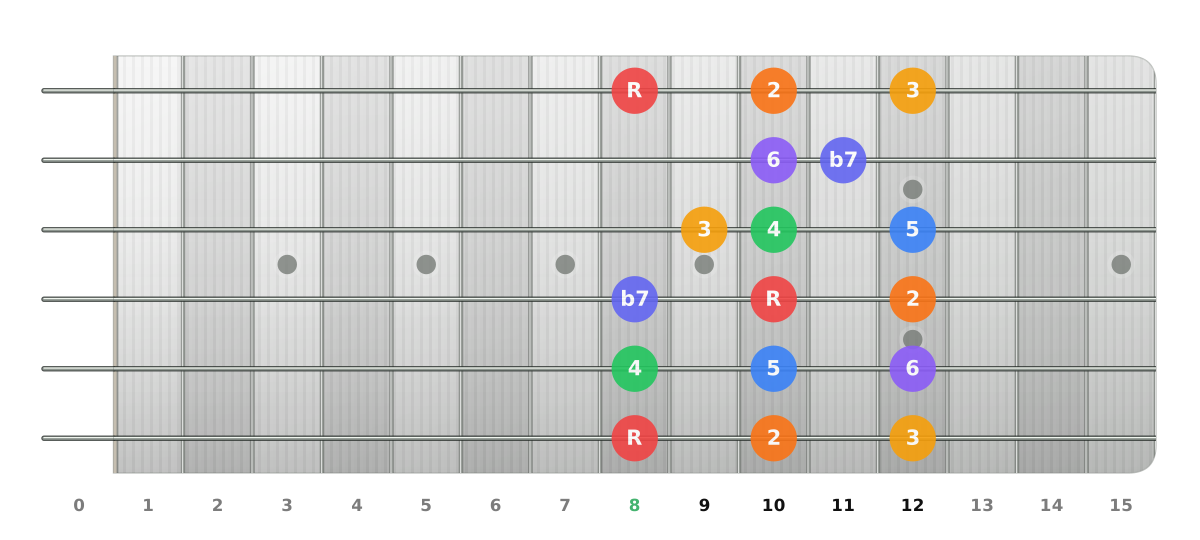
Establish Mixolydian Position 1 and the I dominant 7 tonic so the flat seventh is audible from the first vamp.
5Tracks5Lessons15Targets
Center the Mixolydian map on I while connecting ascending and descending sequences across Position 1.
Isolate the I triad tones while preserving the same focus-first position order.
Build the native I Dominant 7 sound inside the newly introduced Position 1.
Combine the first Mixolydian scale, arpeggio, and chord shapes over a four-bar I vamp.
Add Position 3 and VII major 7, pairing the modal tonic with Mixolydian's defining whole-step-below major color.
6Tracks6Lessons30Targets
Finger exercises to build strength, coordination, and clean fretting from the first session.
Center the Mixolydian map on VII while connecting ascending and descending sequences across Positions 1 + 3.
Isolate the VII triad tones while preserving the same focus-first position order.
Build the native VII Major 7 sound inside the newly introduced Position 3.
Use the new VII sound in short modal movements built only from functions introduced through this stage.
Move between VII in Position 3 and I in Position 1 while keeping the Mixolydian parent map intact.
Add Position 5 and IV major 7 to complete the foundational I-VII-IV Mixolydian movement.
6Tracks6Lessons44Targets
Finger exercises to build strength, coordination, and clean fretting from the first session.
Center the Mixolydian map on IV while connecting ascending and descending sequences across Positions 1 + 3 + 5.
Isolate the IV triad tones while preserving the same focus-first position order.
Build the native IV Major 7 sound inside the newly introduced Position 5.
Use the new IV sound in short modal movements built only from functions introduced through this stage.
Move between IV in Position 5 and I in Position 1 while keeping the Mixolydian parent map intact.
Add Position 2 and the native v minor 7, preserving the mode's softer dominant motion against I7.
6Tracks6Lessons56Targets
Finger exercises to build strength, coordination, and clean fretting from the first session.
Center the Mixolydian map on v while connecting ascending and descending sequences across Positions 1 + 2 + 3 + 5.
Isolate the v triad tones while preserving the same focus-first position order.
Build the native v Minor 7 sound inside the newly introduced Position 2.
Use the new v sound in short modal movements built only from functions introduced through this stage.
Move between v in Position 2 and I in Position 1 while keeping the Mixolydian parent map intact.
Add Position 4 and vi minor 7 as a darker bridge between the tonic and subtonic colors.
6Tracks6Lessons68Targets
Finger exercises to build strength, coordination, and clean fretting from the first session.
Center the Mixolydian map on vi while connecting ascending and descending sequences across Positions 1 + 2 + 3 + 4 + 5.
Isolate the vi triad tones while preserving the same focus-first position order.
Build the native vi Minor 7 sound inside the newly introduced Position 4.
Use the new vi sound in short modal movements built only from functions introduced through this stage.
Move between vi in Position 4 and I in Position 1 while keeping the Mixolydian parent map intact.
Add Position 7 and ii minor 7, opening longer modal cycles while the flat seventh remains the defining color.
6Tracks6Lessons80Targets
Finger exercises to build strength, coordination, and clean fretting from the first session.
Center the Mixolydian map on ii while connecting ascending and descending sequences across Positions 1 + 2 + 3 + 4 + 5 + 7.
Isolate the ii triad tones while preserving the same focus-first position order.
Build the native ii Minor 7 sound inside the newly introduced Position 7.
Use the new ii sound in short modal movements built only from functions introduced through this stage.
Move between ii in Position 7 and I in Position 1 while keeping the Mixolydian parent map intact.
Add Position 6 and iii half-diminished, completing the seven-position Mixolydian map with its most unstable native color.
6Tracks6Lessons92Targets
Finger exercises to build strength, coordination, and clean fretting from the first session.
Center the Mixolydian map on iii° while connecting ascending and descending sequences across all seven positions.
Isolate the iii° triad tones while preserving the same focus-first position order.
Build the native iiiø m7b5 sound inside the newly introduced Position 6.
Use the new iiiø sound in short modal movements built only from functions introduced through this stage.
Move between iiiø in Position 6 and I in Position 1 while keeping the Mixolydian parent map intact.