Harmonic Minor Scales
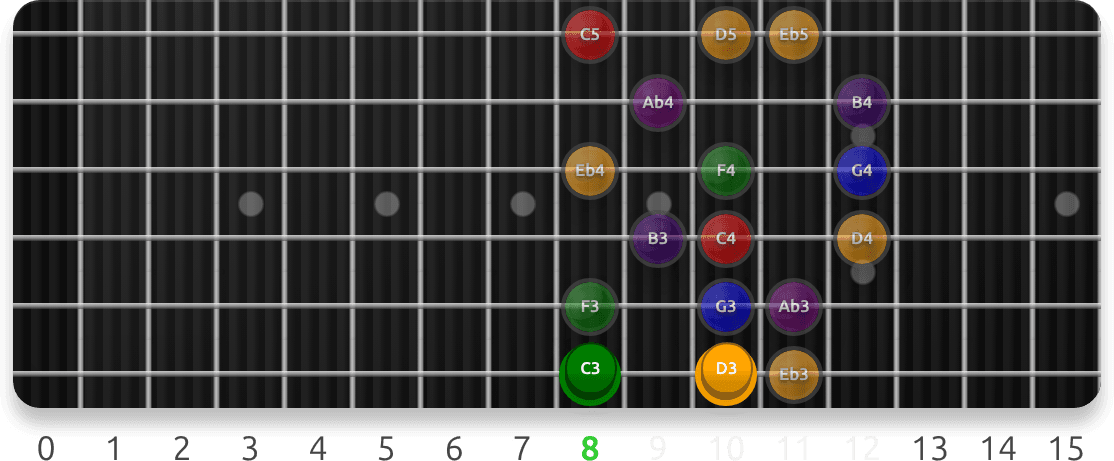
7 interactive lessons focusing on mode and position mapping with clear targets, teaching you to move through positions confidently and phrase with musical intent.
In This Course:
- 7 Lessons
- 49 Exercises
Course Focus:
Scale-first training that maps Harmonic Minor, Locrian, Ionian, Dorian, Phrygian Dominant, Lydian, Super Locrian across positions with focused targets.
Harmonic Minor Scale Lessons
Harmonic Minor Scale Positions
Harmonic Minor Scale PositionsLocrian Scale Positions
Locrian Scale PositionsMajor (Ionian) Scale Positions
Major (Ionian) Scale PositionsDorian Scale Positions
Dorian Scale PositionsPhrygian Dominant Scale Positions
Phrygian Dominant Scale PositionsLydian Scale Positions
Lydian Scale PositionsSuper Locrian Scale Positions
Super Locrian Scale Positions
FAQ
What do harmonic minor scales help you practice?
What do harmonic minor scales help you practice?
It trains Harmonic Minor modes (Harmonic Minor, Locrian, Ionian, Dorian, Phrygian Dominant, Lydian, Super Locrian) across fretboard positions (patterns/boxes) with a focus on intentional resolution.
How can I incorporate this course into my playing?
How can I incorporate this course into my playing?
Use Jam Mode to generate a computer-backed groove (bass + chords), then loop each lesson in this course in time. Keep the End Note target consistent and practice landing cleanly on beat 1.
What is the difference between this system and other teaching systems?
What is the difference between this system and other teaching systems?
Some systems (like CAGED or 3-notes-per-string) group the same fretboard information differently. ScaleMode.Pro uses Hand Position Organization (Position 1–7 and Position 1–5 for pentatonic/blues) so your labels stay consistent.
How does Start/End Note targeting improve phrasing?
How does Start/End Note targeting improve phrasing?
It turns every run into a destination exercise: you practice resolving to a chosen degree (often a chord tone). Repeating that skill builds real phrasing, not random scale motion.
Why does “Phrygian dominant” show up so often?
Why does “Phrygian dominant” show up so often?
It’s a common harmonic minor mode name with a distinctive sound that guitarists use over dominant or minor-key contexts. Mapping it by position helps you hear the color instead of guessing.
More Courses
Pricing
Pro Yearly
Best value: 25% savings with yearly
- Learn guitar without getting lost on the fretboard
- Get instant note feedback through your microphone
- Follow step-by-step lessons that keep you moving
- Practice with backing grooves that make it stick
- Save your best drills and come back to them fast
- Track your progress and stay motivated to improve
Pro Monthly
- Learn guitar without getting lost on the fretboard
- Get instant note feedback through your microphone
- Follow step-by-step lessons that keep you moving
- Practice with backing grooves that make it stick
- Save your best drills and come back to them fast
- Track your progress and stay motivated to improve
Pro Yearly
Best value: 25% savings with yearly
- Learn guitar without getting lost on the fretboard
- Get instant note feedback through your microphone
- Follow step-by-step lessons that keep you moving
- Practice with backing grooves that make it stick
- Save your best drills and come back to them fast
- Track your progress and stay motivated to improve
AboutWritten by Stephen Magreni • Last updated February 6, 2026
- Scale-first training that maps Harmonic Minor, Locrian, Ionian, Dorian, Phrygian Dominant, Lydian, Super Locrian across positions with focused targets.
- Start/End Note targets by degree are enabled for this course (including negatives and zero when available).
- Apply the same targets in time with Jam Mode backing grooves.
Credentials: BA University of Pittsburgh — Music Theory. Focuses on musicianship, composition, electronic music, and jazz guitar.